The Real Difference Between 4G, 5G, and Wi-Fi 6
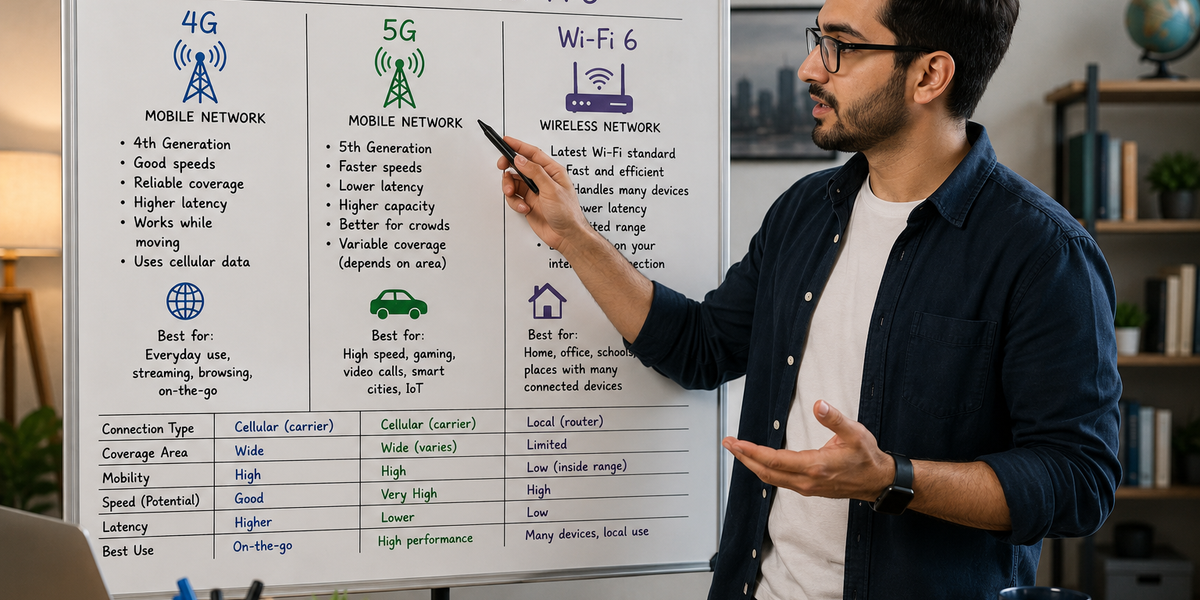
4G, 5G, and Wi-Fi 6 are often discussed as if they are competing versions of the same technology. They all provide wireless internet access, but they are designed for different types of connections.
4G and 5G are mobile network technologies. They connect phones and other devices through cellular towers operated by mobile carriers.
Wi-Fi 6 is a wireless networking standard. It usually connects devices to a nearby router inside a home, office, school, airport, or other location.
The simplest difference is this: 4G and 5G provide internet access while you move across large areas, while Wi-Fi 6 provides a fast local connection within range of a router.
What Is 4G?
4G is the fourth generation of mobile network technology. It became widely available during the 2010s and made modern mobile internet practical.
Earlier mobile networks were mainly designed for calls, text messages, and basic web browsing. 4G provided the speed and capacity needed for video streaming, mobile apps, video calls, online gaming, and social media.
When your phone displays “4G” or “LTE,” it is connected to a nearby cellular tower. The tower communicates with your mobile carrier’s network, which then connects you to the internet.
4G covers large geographic areas and allows your phone to remain connected while you travel between neighborhoods or cities. As you move, the network transfers your connection from one cell tower to another.
Actual speeds vary depending on location, network congestion, signal strength, and the carrier. In many situations, 4G is fast enough for everyday activities such as streaming video, browsing, messaging, and remote work.
What Is 5G?
5G is the fifth generation of mobile network technology and the successor to 4G.
It was designed to provide faster speeds, lower latency, and greater network capacity.
Latency is the delay between sending information and receiving a response. Lower latency can make online activities feel more immediate, especially video calls, cloud applications, gaming, and connected systems that depend on fast communication.
One major advantage of 5G is its ability to support many connected devices in busy areas. Stadiums, city centers, airports, and large events can place heavy demand on mobile networks. Greater capacity can help networks manage that traffic more effectively.
However, 5G performance varies significantly.
Some 5G networks use lower-frequency signals that travel farther and provide wider coverage. Their speeds may be similar to strong 4G connections.
Other 5G networks use higher-frequency signals that can provide very fast speeds but have shorter range and may be more easily blocked by buildings, walls, trees, and other obstacles.
This is why seeing a 5G symbol does not always mean your connection will be dramatically faster than 4G.
What Is Wi-Fi 6?
Wi-Fi 6 is a newer generation of Wi-Fi technology. Its technical name is 802.11ax.
Unlike 4G and 5G, Wi-Fi 6 does not usually connect directly to a mobile carrier. It connects your device to a nearby wireless router.
The router then connects to the internet through a separate service, such as fiber, cable, or another broadband connection.
Wi-Fi 6 was designed to improve speed, efficiency, and performance when many devices are connected to the same network.
Modern homes may have phones, laptops, televisions, tablets, security cameras, speakers, gaming systems, watches, and smart appliances all using Wi-Fi at the same time.
Older Wi-Fi networks may slow down when many devices compete for access. Wi-Fi 6 manages multiple connections more efficiently, helping reduce congestion and improve overall performance.
Speed Is Only Part of the Difference
People often compare wireless technologies using maximum advertised speeds. These numbers can be useful, but they do not always reflect everyday performance.
Your actual speed depends on many factors.
For 4G and 5G, performance may be affected by:
- Distance from the cellular tower
- Buildings and other obstacles
- The number of people using the network
- Your mobile carrier
- Your phone and data plan
For Wi-Fi 6, performance may depend on:
- The speed of your home internet connection
- Distance from the router
- Walls and interference
- Router quality
- The number of connected devices
- Whether your device supports Wi-Fi 6
A Wi-Fi 6 router cannot make a slow internet plan faster. If your broadband connection provides 100 megabits per second, upgrading the router does not automatically increase that speed.
However, it may improve how efficiently the available connection is shared among devices.
Coverage Works Differently
4G is designed for broad coverage. A single cellular tower can serve a large area, and networks use many towers to maintain connections across cities, roads, and rural regions.
5G also provides wide-area mobile coverage, but its range depends on the frequencies being used. Some 5G signals travel long distances, while high-frequency versions require more network equipment placed closer together.
Wi-Fi 6 is designed for a much smaller area.
A Wi-Fi router may provide coverage throughout a home or office, but the signal becomes weaker with distance and physical barriers.
If you leave the building, your device will usually disconnect from Wi-Fi and switch to 4G or 5G.
Which One Has Lower Latency?
5G was designed to provide lower latency than 4G, although real-world results depend on the network.
Lower latency can improve activities that require quick responses, such as online gaming, live video, remote control systems, and certain industrial applications.
Wi-Fi 6 can also provide low latency, particularly when the router is nearby and the local network is not congested.
However, the total delay depends on more than the wireless connection. Your internet provider, network traffic, the distance to the server, and the online service itself also affect latency.
Is Wi-Fi 6 Faster Than 5G?
Sometimes, but not always.
A Wi-Fi 6 connection using fast fiber internet may be much faster and more stable than a mobile 5G connection.
In another location, a strong 5G connection may outperform Wi-Fi connected to a slow broadband service.
The technologies cannot be compared by name alone because they depend on different infrastructure.
Wi-Fi 6 describes the connection between your device and the router. It does not describe the speed of the internet service reaching the router.
5G provides both the wireless connection and access to the mobile carrier’s network.
Do You Need a New Device?
To use 5G, you need a phone or device with a compatible 5G modem. You also need access to a carrier that provides 5G coverage.
To receive the full benefits of Wi-Fi 6, both the router and the connected device should support Wi-Fi 6.
Older devices can usually connect to a Wi-Fi 6 router because the technology is designed to work with previous Wi-Fi generations. However, they will not receive every Wi-Fi 6 improvement.
Upgrading only one part of the system may provide limited benefits.
Which One Should You Use?
In most cases, you do not need to choose only one.
4G remains useful because it provides reliable mobile coverage in many areas and works with a large number of devices.
5G may provide faster speeds, lower latency, and better performance in crowded locations when strong coverage is available.
Wi-Fi 6 is useful in homes, offices, and other spaces where many devices share one internet connection.
Your phone may use Wi-Fi 6 while you are at home, switch to 5G when you leave, and use 4G when 5G coverage is unavailable.
The technologies are designed to work alongside one another.
4G provides broad and established mobile coverage. 5G expands mobile speed, capacity, and responsiveness. Wi-Fi 6 improves local wireless connections, especially in places with many connected devices.
The best connection is not always the one with the newest name. It is the one that provides reliable speed, coverage, and performance where you actually use it.