How Large Language Models Like ChatGPT Generate Text
Large language models can answer questions, summarize documents, write emails, explain difficult topics, generate computer code, and continue conversations in a way that often feels natural.
The basic process behind these abilities is simpler than it may appear: a large language model generates text by predicting what should come next.
It does not usually retrieve a complete answer from a database or select a prewritten response. Instead, it creates text one small piece at a time using patterns learned during training.
The technology behind that process is complex, but understanding the main ideas does not require advanced mathematics.
What Is a Large Language Model?
A large language model, or LLM, is an AI system trained to recognize and generate patterns in language.
The word large refers partly to the size of the model and the amount of data and computing power involved in developing it.
The word language describes the type of information it is designed to process, including words, sentences, code, conversations, and other forms of text.
A model is a system that has learned patterns from data and can use those patterns to make predictions.
During training, an LLM processes large collections of text. It learns relationships between words, grammar, writing styles, facts, ideas, and patterns of reasoning.
It does not store everything as a searchable library of complete sentences. Much of what it learns is represented through internal numerical relationships.
Text Is Divided Into Tokens
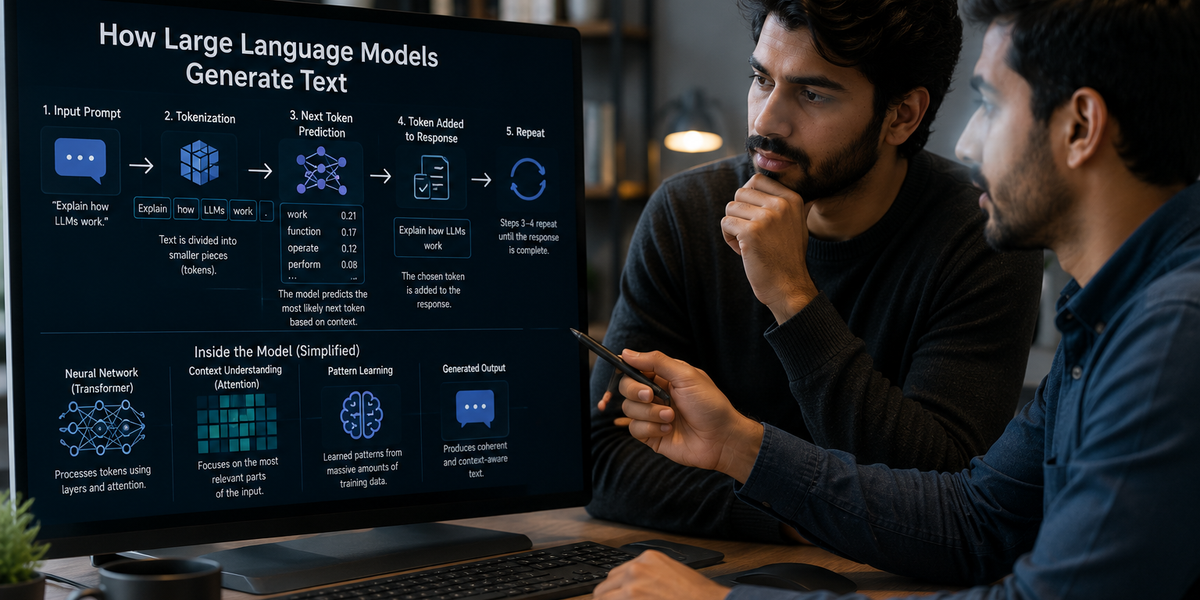
Before a language model can process a sentence, the text is divided into smaller units called tokens.
A token may be:
- A complete word
- Part of a word
- Punctuation
- A number
- A short sequence of characters
For example, a sentence such as:
“The dog is running.”
might be divided into pieces representing “The,” “dog,” “is,” “running,” and the period.
Long or unusual words may be split into several tokens.
The model processes these tokens rather than reading language exactly as people do.
Tokenization allows the system to work with common pieces of language and combine them in many different ways.
The Model Learns by Predicting Missing or Next Words
During training, the model repeatedly practices predicting text.
Imagine the sentence:
“The capital of France is ___.”
The expected continuation is “Paris.”
If the model predicts the wrong answer, its internal settings are adjusted slightly.
This process happens across enormous amounts of text and many examples.
The model encounters patterns involving facts, grammar, explanations, conversations, stories, computer code, and different writing styles.
Over time, it becomes better at predicting which words or tokens are likely to appear in different contexts.
Training is not simply memorizing a list of correct answers. The model develops a large network of relationships that can be applied to new prompts.
What Happens When You Enter a Prompt?
When you type a question, your words are converted into tokens.
The model examines those tokens along with the available conversation context.
It then estimates which token would be the most appropriate next part of the response.
Suppose you write:
“Water freezes at…”
The model may assign a high probability to a continuation such as “0 degrees Celsius.”
After generating that token, it considers the updated sentence and predicts the next token.
The process repeats many times:
- Read the available context
- Predict a suitable next token
- Add the token to the response
- Use the updated text to make the next prediction
This continues until the answer is complete.
Although the model generates one token at a time, the process happens quickly enough that the response appears as flowing text.
The Model Does Not Always Choose the Most Likely Word
If a language model always selected the single most likely next word, its writing could become repetitive and predictable.
Instead, the system may choose from several likely possibilities.
The amount of variation can be adjusted. More variation may produce creative or unexpected responses, while less variation may produce more consistent and focused answers.
The model is not selecting words randomly without context. Its choices are influenced by the prompt, conversation, learned patterns, and instructions guiding the response.
This balance allows the same model to write a formal report, explain a topic simply, create a story, or generate computer code.
How Does the Model Understand Context?
Modern language models use a neural network design known as a transformer.
One important feature of transformers is called attention.
Attention helps the model determine which parts of the text are most relevant when generating the next part of a response.
Consider the sentence:
“Maria put the cake in the refrigerator because it needed to stay cold.”
To understand what “it” refers to, the model needs to connect the word with “the cake.”
Attention helps identify these relationships even when relevant words are separated by other text.
In longer conversations, the model can also use earlier messages as context.
However, there is a limit to how much information a model can process at one time. This is often called the context window.
Information outside that limit may no longer be available unless it is summarized, stored separately, or provided again.
Does ChatGPT Search the Internet for Every Answer?
Not necessarily.
A language model can answer many questions using patterns and information developed during training.
That does not mean it is opening websites or searching a live database each time it responds.
Some AI systems can use additional tools to search the web, read documents, analyze files, or access current information. When those tools are used, the model can include information beyond its training data.
Without access to an external source, the model may not know about recent events or updates.
This is why current information should sometimes be checked against reliable sources.
Does an LLM Copy Text From Its Training Data?
Language models are designed to learn patterns rather than store and reproduce entire documents.
When generating a response, the model usually creates new combinations of language based on what it learned.
However, models may occasionally reproduce familiar phrases or portions of text, particularly when material appeared frequently or repeatedly in training data.
Developers use training methods and safety systems to reduce inappropriate reproduction of protected or sensitive content.
The model’s main function is generation, not searching through a collection of stored passages.
Why Can LLMs Answer Questions About So Many Topics?
Language contains information about many areas of human knowledge.
During training, a model may encounter writing about science, history, business, technology, literature, mathematics, law, culture, and many other subjects.
Learning relationships across this information allows the model to respond to a wide variety of questions.
The same underlying process is used whether the model is explaining gravity, drafting an email, summarizing a report, or writing code.
The prompt changes the context, and the model generates text that fits that context.
Why Do Language Models Sometimes Give Wrong Answers?
A language model generates responses based on patterns and probability. It does not automatically verify every statement before presenting it.
This can lead to incorrect information that sounds convincing.
These errors are often called hallucinations.
A model may:
- Invent a source
- Provide an incorrect date
- Confuse two people or events
- Misinterpret a question
- Describe something that does not exist
- Fill missing information with a plausible but false answer
The system is optimized to produce useful and coherent language, but coherence is not the same as truth.
For important information, especially involving health, law, finances, safety, or current events, responses should be checked against reliable sources.
How Models Become More Helpful
Initial language training teaches a model how language works, but additional training can help it respond more effectively.
Human reviewers may evaluate answers and provide feedback about usefulness, accuracy, clarity, and safety.
The model can then be adjusted to better follow instructions, avoid harmful responses, explain uncertainty, and communicate more naturally.
Developers may also use automated evaluations, safety testing, and real-world feedback to improve future versions.
This does not make the model perfect. It still has limitations and can misunderstand instructions or generate incorrect information.
Does ChatGPT Think Like a Person?
Language models can produce explanations, solve certain problems, compare ideas, and respond in ways that resemble human reasoning.
However, generating human-like language does not necessarily mean experiencing thoughts in the way people do.
An LLM does not need personal memories, emotions, beliefs, or awareness to generate a sentence that sounds thoughtful.
Its responses come from processing context and applying patterns learned during training.
The result can be useful and sophisticated without being identical to human understanding.
What Is Happening Behind Every Response?
When you ask a question, the model processes your prompt, considers the conversation context, and predicts a suitable continuation.
It generates one token, updates the context, and predicts the next.
Those small predictions build into sentences, paragraphs, explanations, stories, or code.
Large language models can appear knowledgeable because they have learned complex relationships across enormous amounts of language.
Their ability is powerful, but it has limits. They can generate useful explanations and original responses while still making factual mistakes.
Understanding how they work makes it easier to use them effectively: provide clear instructions, include relevant context, ask for clarification when needed, and verify important information rather than assuming that confident language is always correct.