The Difference Between Stocks, Bonds, and Index Funds
Investing can feel complicated because many financial terms are used without simple explanations. Three of the most common are stocks, bonds, and index funds.
Each works differently and comes with its own level of risk and potential return. Stocks represent ownership in a company. Bonds are a form of lending. Index funds are investment funds that hold a collection of assets, often many different stocks or bonds.
Understanding these differences can help you make more informed investment decisions.
What Are Stocks?
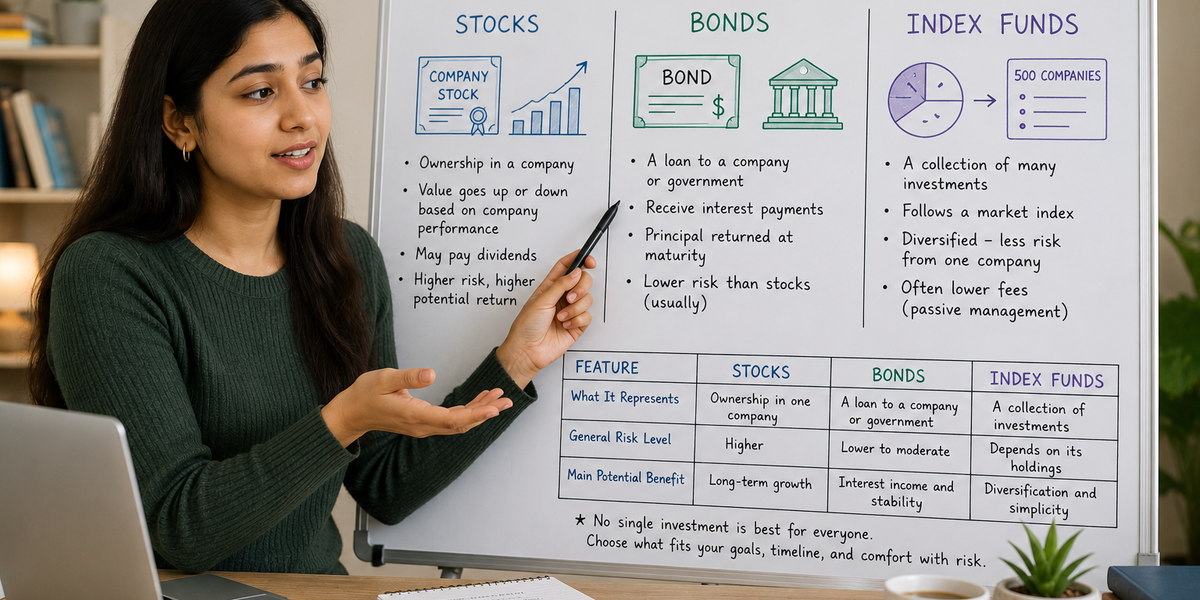
A stock represents a small ownership share in a company.
When you buy stock, you become a shareholder. If the company grows and becomes more valuable, the price of your shares may increase. You can then sell them for more than you paid.
Some companies also distribute part of their profits to shareholders through payments called dividends.
For example, if you buy ten shares at $50 each, your investment is worth $500. If the share price increases to $70, the investment becomes worth $700. However, if the price falls to $30, its value drops to $300.
Stocks can provide strong long-term growth, but their prices may change significantly. Company performance, economic conditions, industry trends, and investor expectations can all affect their value.
Investing in one company also creates concentration risk. If that company performs poorly, a large portion of your investment may lose value.
What Are Bonds?
A bond is essentially a loan made to a government, company, or other organization.
When you buy a bond, you are lending money to the issuer. In return, the issuer generally agrees to make interest payments and repay the original amount when the bond reaches its maturity date.
For example, imagine buying a $1,000 bond that pays 4% annual interest. You may receive $40 in interest each year and receive the original $1,000 when the bond matures, assuming the issuer meets its obligations.
Bonds are generally considered less volatile than stocks, but they are not risk-free.
If interest rates rise, existing bonds may become less valuable because newer bonds may offer higher returns. There is also a risk that the issuer could fail to make payments.
Government bonds issued by financially stable countries are often considered lower risk, while bonds from companies or less stable issuers may offer higher interest rates to compensate for greater risk.
What Are Index Funds?
An index fund is an investment fund designed to follow the performance of a market index.
Instead of choosing individual companies, an index fund may invest in hundreds or thousands of assets at once.
For example, a fund tracking a broad stock market index may hold shares in many large companies. When you invest in the fund, your money is spread across those companies rather than depending on the performance of a single business.
This diversification can reduce the impact of one company performing poorly.
Index funds can be structured as mutual funds or exchange-traded funds, commonly known as ETFs. Some track stocks, while others track bonds or specific industries and regions.
Many index funds use a passive investment strategy. Rather than paying managers to choose investments actively, the fund follows a defined index. This often results in lower fees, although costs vary between funds.
Stocks vs. Bonds
The main difference between stocks and bonds is ownership versus lending.
When you buy a stock, you own part of a company. Your potential return depends largely on the company’s performance and changes in its market value.
When you buy a bond, you lend money to an organization. Your expected payments are usually defined in advance, although the value of the bond may change before maturity.
Stocks generally offer greater potential for long-term growth but tend to experience larger price changes.
Bonds often provide more predictable income and may be less volatile, but their long-term returns are generally lower than those of stocks.
Stocks vs. Index Funds
A stock is an investment in one company. A stock index fund is an investment in a collection of companies.
Buying shares in one company means your results depend heavily on that company’s performance.
An index fund spreads the investment across many companies. Some will perform well, while others may perform poorly. This reduces the effect of any single company on the overall investment.
However, diversification does not eliminate risk. If the overall market declines, a broad index fund may also lose value.
Bonds vs. Bond Index Funds
You can buy individual bonds or invest through a bond index fund.
An individual bond generally has a defined maturity date and payment structure. A bond index fund holds many bonds and regularly adjusts its investments to follow an index.
Bond funds provide diversification and may be easier to access, but they do not behave exactly like individual bonds. Their value can rise or fall, and they do not provide the same promise of receiving a specific principal amount on one maturity date.
A Simple Comparison
Investment
Stock
Bond
Index fund
What It Represents
Ownership in one company
A loan to a company or government
A collection of investments
General Risk Level
Higher
Lower to moderate
Depends on its holdings
Main Potential Benefit
Long-term growth
Interest income and stability
Diversification and simplicity
Risk levels vary. A risky corporate bond may be more volatile than some stocks, while an index fund focused on one industry may be less diversified than a broad-market fund.
Which One Is Better?
There is no single investment that is best for everyone.
The right choice depends on your financial goals, time horizon, income needs, and ability to handle changes in value.
Someone investing for a long-term goal may be more comfortable holding a larger share of stocks. Someone who expects to need the money sooner may prefer more stable investments.
Many investors use a combination of stock and bond index funds. The purpose is to balance growth potential with stability and diversification.
Final Thoughts
Stocks, bonds, and index funds serve different purposes.
Stocks provide ownership in individual companies and may offer strong growth, but they can be volatile. Bonds involve lending money and may provide more predictable income, although they still carry risk. Index funds hold collections of investments and can offer diversification without requiring investors to choose every asset individually.
Understanding what you own, how it may generate returns, what fees apply, and how much risk is involved is more important than following investment trends.
The best investment approach is one that fits your goals, timeline, financial situation, and comfort with risk.