The 50/30/20 Budget Explained
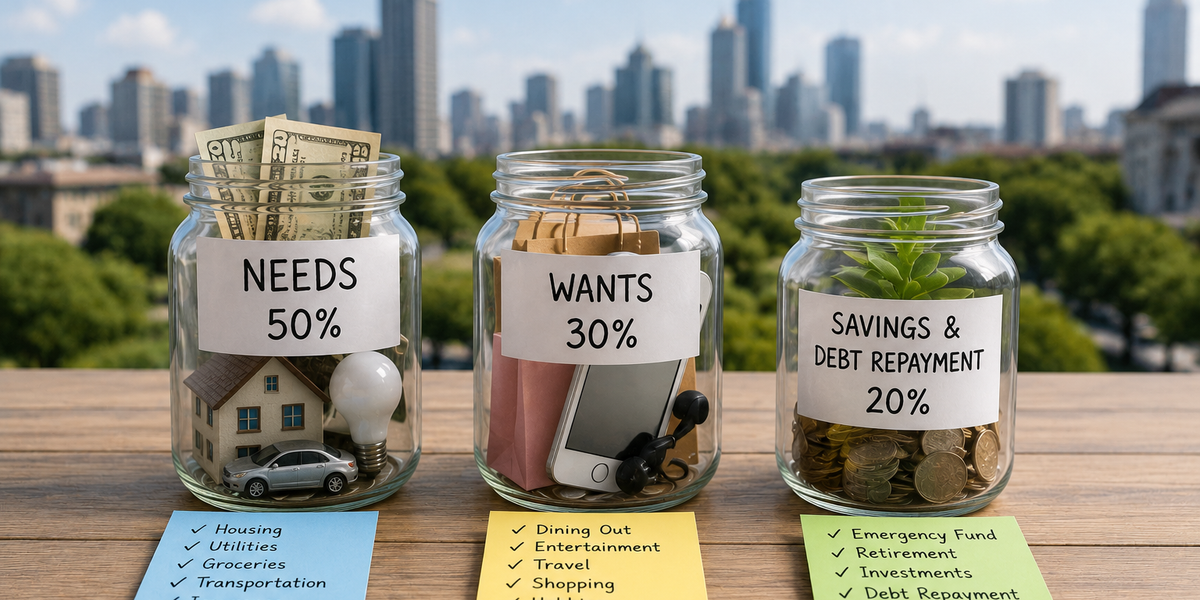
Budgeting can feel complicated when every expense is divided into dozens of categories. The 50/30/20 budget simplifies the process by separating your after-tax income into only three groups: needs, wants, and savings or debt repayment.
The basic idea is:
- 50% for needs
- 30% for wants
- 20% for savings and additional debt repayment
The rule is not meant to control every purchase or require perfect percentages each month. It is a flexible framework that helps you balance current expenses, lifestyle choices, and future financial goals.
Here is how it works and how to decide whether it fits your financial situation.
How the 50/30/20 Budget Works
The first step is to calculate your monthly after-tax income.
This is the amount that reaches your bank account after income taxes and other required deductions. If deductions such as health insurance or retirement contributions are automatically taken from your paycheck, you may need to consider how those expenses fit into the budget.
Suppose your monthly after-tax income is $4,000.
Using the 50/30/20 approach, you would divide it like this:
- $2,000 for needs
- $1,200 for wants
- $800 for savings and additional debt payments
These amounts provide spending targets rather than strict limits. Your actual percentages may need to change depending on your income, location, family responsibilities, debt, and financial goals.
50% for Needs
Needs are essential expenses you must pay to maintain your basic生活 and meet important obligations.
They may include:
- Rent or mortgage payments
- Utilities
- Groceries
- Basic transportation
- Insurance
- Healthcare
- Childcare
- Minimum debt payments
- Essential household expenses
A useful question is:
Would avoiding this expense create a serious financial, legal, health, or practical problem?
If the answer is yes, it is probably a need.
However, the difference between a need and a want is not always clear.
Housing is a need, but choosing a more expensive home than necessary may partly reflect a lifestyle preference. Transportation is a need for many people, but a luxury vehicle may include both necessary and optional costs.
The goal is not to judge spending. It is to understand which expenses are essential and how much of your income they require.
30% for Wants
Wants are expenses that improve your lifestyle but are not essential.
They may include:
- Restaurant meals
- Entertainment
- Travel
- Streaming subscriptions
- Hobbies
- Nonessential shopping
- Premium services
- Concerts and events
- Upgraded technology
Wants are not automatically wasteful. A sustainable budget should leave room for enjoyment, convenience, and experiences.
The purpose of the 30% category is to create a limit that allows you to enjoy your income without allowing optional spending to interfere with essential expenses or long-term goals.
Some expenses may fall into both categories. Groceries are generally a need, while frequent restaurant meals are usually considered wants. A basic phone plan may be necessary, while an expensive upgrade may be optional.
What matters is being consistent and realistic about how you classify your spending.
20% for Savings and Debt Repayment
The final 20% is used to improve your future financial position.
This category may include:
- Emergency savings
- Retirement contributions
- Investments
- Saving for a home
- Education savings
- Additional loan payments
- Credit card debt repayment
- Other long-term financial goals
Minimum debt payments are generally treated as needs because they are required. Payments above the minimum can be included in the 20% category because they help reduce debt faster.
If you have high-interest debt, you may choose to direct most of this category toward repayment before increasing long-term investments.
If you do not yet have emergency savings, building a financial cushion may be an early priority. An emergency fund can help cover unexpected expenses without relying on credit cards or loans.
A Simple Example
Imagine your monthly after-tax income is $3,000.
Using the 50/30/20 framework:
Category Percentage Monthly Amount
Needs 50% $1,500
Wants 30% $900
Savings and additional 20% $600
debt payments
Your needs might include:
- Rent: $850
- Utilities: $150
- Groceries: $300
- Transportation: $120
- Insurance: $80
Total: $1,500
Your wants might include:
- Restaurants: $250
- Entertainment: $150
- Shopping: $200
- Travel savings: $200
- Subscriptions: $100
Total: $900
The remaining $600 might be divided between emergency savings, retirement investing, and additional debt repayment.
The exact amounts can change each month as long as the overall structure continues supporting your priorities.
What If Your Needs Are More Than 50%?
For many people, keeping essential expenses below 50% is difficult.
Housing, childcare, healthcare, transportation, and food costs may already consume most of a household’s income. This is especially common in expensive cities or during periods of high inflation.
If your needs take up 60% or 70% of your income, the budget has not failed. The percentages simply may not reflect your current reality.
Begin by calculating your actual spending rather than forcing expenses into unrealistic limits.
You may temporarily use a different structure, such as:
- 60% for needs
- 20% for wants
- 20% for savings and debt repayment
Or:
- 70% for needs
- 20% for wants
- 10% for savings
The most important goal is to create a plan that is realistic enough to follow.
What If You Cannot Save 20%?
Saving 20% may not be immediately possible, especially if you have a low income, high essential expenses, or significant debt.
Start with an amount you can maintain.
Saving 5% consistently may be more useful than attempting to save 20%, becoming financially stretched, and giving up after a few months.
You can gradually increase the percentage when your income rises, debt decreases, or major expenses change.
Even small automatic contributions can build momentum over time.
Does Debt Repayment Count as Saving?
Additional debt payments can improve your financial position because they reduce future interest costs and increase the amount of income available later.
For example, if you pay more than the required minimum on a high-interest credit card, the additional payment can be included in the 20% category.
However, minimum payments belong in the needs category because they are required expenses.
Paying off expensive debt may sometimes provide a greater financial benefit than adding more money to savings, although maintaining some emergency funds can help prevent new debt when unexpected costs arise.
How to Start Using the 50/30/20 Budget
Begin by reviewing your income and spending from the past one to three months.
Calculate your average after-tax income and organize expenses into needs, wants, and savings or additional debt repayment.
Then compare your current percentages with the 50/30/20 targets.
Do not try to change everything at once. Look for one or two realistic adjustments.
You might cancel unused subscriptions, reduce restaurant spending, compare insurance costs, or automate a monthly savings transfer.
Review the budget regularly and adjust it when your income, expenses, or goals change.
Benefits of the 50/30/20 Budget
The main advantage is simplicity.
You do not need to track dozens of categories or set a limit for every type of purchase. The framework provides enough structure to guide decisions while allowing flexibility.
It also encourages balance. Essential expenses are covered, enjoyable spending has a place, and part of your income is directed toward future goals.
For people who find detailed budgeting stressful or difficult to maintain, three broad categories may be easier to manage.
Limitations of the 50/30/20 Budget
The rule does not work equally well for everyone.
It may be difficult for people living in high-cost areas, supporting large families, paying for childcare, managing medical expenses, or earning an irregular income.
The 30% allowance for wants may also be too high for someone trying to pay off debt quickly or reach an ambitious savings goal.
The framework does not tell you which financial goals to prioritize. You still need to decide how to divide the final 20% among emergency savings, retirement, investing, and debt repayment.
Think of the rule as a starting point rather than a universal financial formula.
Final Thoughts
The 50/30/20 budget divides after-tax income into three categories: 50% for needs, 30% for wants, and 20% for savings and additional debt repayment.
Its strength is simplicity. It creates a balance between paying essential expenses, enjoying life today, and preparing for the future.
However, the percentages are guidelines—not requirements.
If your needs are higher than 50% or saving 20% is not currently realistic, adjust the framework to fit your situation. A budget is useful only when it reflects your actual income, responsibilities, and goals.
The best budget is not the one with perfect percentages. It is the one you can follow consistently while making steady financial progress.