How to Write a Resume That Actually Gets Read
Most recruiters do not read every resume from top to bottom. They scan quickly, looking for evidence that the applicant has the skills and experience needed for the role.
That means your resume has two jobs: make the important information easy to find and give the reader a reason to keep going.
A strong resume does not need complicated graphics, long descriptions, or exaggerated language. It needs to show what you have done, what you are good at, and how your experience relates to the job.
Start With the Job Description
Before editing your resume, read the job description carefully.
Identify the main skills, responsibilities, tools, qualifications, and experience the employer mentions. Pay attention to terms that appear more than once.
If the position requires project management, client communication, budget oversight, and reporting, your resume should clearly show relevant experience in those areas.
Do not copy the job description word for word or claim skills you do not have. Use the employer’s language when it accurately describes your experience.
This can also help applicant tracking systems identify relevant information.
Make the Top Section Useful
The first part of your resume should immediately answer basic questions:
- Who are you professionally?
- What type of work do you do?
- What experience or strengths are most relevant?
Include your name, phone number, professional email address, location, and a relevant portfolio or professional profile when appropriate.
You do not usually need to include a full home address.
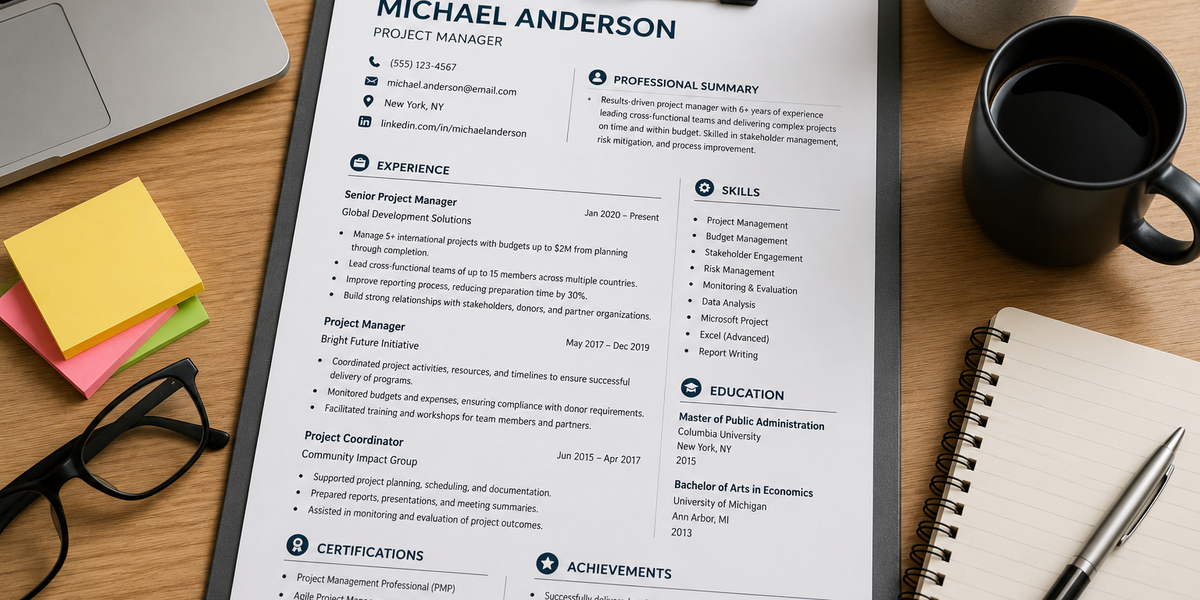
A short professional summary can be useful if it is specific.
Avoid statements such as:
“Hardworking and motivated professional seeking an exciting opportunity to grow.”
This could describe almost anyone.
A stronger summary might say:
“Project manager with six years of experience leading international development programs, coordinating cross-sector partners, and managing donor-funded projects.”
The second version gives the reader useful information immediately.
Focus on Achievements, Not Only Responsibilities
Many resumes read like job descriptions.
They list tasks:
- Managed projects
- Attended meetings
- Prepared reports
- Communicated with clients
These statements explain what the person was expected to do but not how well they did it.
Whenever possible, describe results.
For example:
“Managed five donor-funded projects with a combined annual budget of $1.2 million.”
“Redesigned the monthly reporting process, reducing preparation time by 30%.”
“Coordinated a regional conference attended by more than 400 participants.”
Numbers help when they are accurate, but not every achievement needs a percentage.
You can also show impact by explaining what improved, changed, grew, or became more efficient.
Use Strong, Direct Language
Begin bullet points with clear action verbs.
Useful examples include:
- Led
- Managed
- Created
- Increased
- Reduced
- Coordinated
- Developed
- Improved
- Negotiated
- Implemented
Avoid weak phrases such as:
“Responsible for managing…”
Write:
“Managed…”
The second version is shorter and more direct.
Avoid filling the resume with business language that sounds impressive but provides little information.
Phrases such as “results-driven professional,” “dynamic team player,” and “strategic thinker” are more convincing when demonstrated through experience.
Keep It Easy to Scan
Recruiters should be able to find important information quickly.
Use:
- Clear section headings
- Consistent formatting
- Short bullet points
- Readable fonts
- Enough white space
- Reverse chronological order
Avoid large blocks of text.
Most resumes include sections such as:
- Professional summary
- Work experience
- Education
- Skills
- Certifications
Additional sections may include languages, publications, volunteer experience, awards, or projects when relevant.
Your most important information should not be hidden at the bottom of the page.
Choose the Right Length
One page is often appropriate for students, recent graduates, and professionals with limited experience.
Two pages may be reasonable for people with several years of relevant work, technical experience, leadership roles, research, or major projects.
Do not remove important achievements simply to force the resume onto one page.
At the same time, avoid including every job, course, responsibility, or achievement from your entire career.
Older or unrelated experience can be shortened.
Every section should help explain why you are a strong candidate for the role.
Tailor the Resume for Each Job
Sending the same resume to every employer may save time, but it can reduce relevance.
You do not need to rewrite everything for every application.
Adjust the summary, skills, and strongest experience points to match the position.
For a project management role, emphasize planning, budgets, stakeholders, deadlines, and delivery.
For a communications role, focus more on writing, campaigns, media, content, and audience engagement.
The experience may be the same, but the emphasis should reflect the job.
Include the Right Keywords
Many employers use applicant tracking systems to organize applications.
These systems may search for terms connected with the role.
If a job description repeatedly mentions a specific tool, qualification, or skill that you genuinely have, include it naturally.
For example, if the employer requests experience with Salesforce, do not write only “customer relationship management software.” Include the specific name.
Avoid hiding keywords or adding long lists of skills you cannot demonstrate.
Keywords may help a resume reach a recruiter, but the content still needs to make sense to a person.
Keep the Skills Section Specific
Avoid vague skills such as:
- Communication
- Leadership
- Teamwork
- Hardworking
These qualities matter, but they are difficult to evaluate without examples.
Include specific skills that are relevant to the role, such as:
- Budget management
- Data analysis
- Grant writing
- Adobe Creative Suite
- Salesforce
- SQL
- Project scheduling
- Financial reporting
Your experience section should support the skills you list.
Avoid Unnecessary Personal Information
Resume expectations vary by country, but many employers do not need information such as:
- Age
- Marital status
- Religion
- Identification numbers
- Full home address
A photo may be common in some countries and discouraged in others.
Research local expectations before applying internationally.
Do not include references unless they are requested. The phrase “References available upon request” is usually unnecessary.
Check for Errors
A spelling mistake may not automatically disqualify you, but repeated errors can suggest a lack of attention.
Before submitting:
- Check spelling and grammar
- Confirm job titles and dates
- Test every link
- Use consistent punctuation
- Review spacing and alignment
- Make sure contact information is correct
Read the resume aloud. Awkward or overly long sentences are easier to notice when spoken.
Ask another person to review it as well. They may notice unclear wording or missing information.
Use a Simple File Format
Follow the employer’s instructions.
PDF is often a good choice because it preserves formatting, but some application systems may request a Word document.
Use a professional filename, such as:
Maria_Santos_Resume.pdf
Avoid names such as:
resume_final_new_version3.pdf
Open the file after saving it to confirm that the layout still looks correct.
What Makes a Resume Worth Reading?
A strong resume is clear, relevant, and specific.
It does not try to include everything you have ever done. It highlights the experience that matters most for the position.
Before submitting, ask:
Can someone understand my professional background within a few seconds?
Are my strongest achievements easy to find?
Does the resume show results rather than only responsibilities?
Is it clearly connected to the job?
Your resume does not need to tell your entire career story. It needs to make the reader interested enough to invite you to the next conversation.