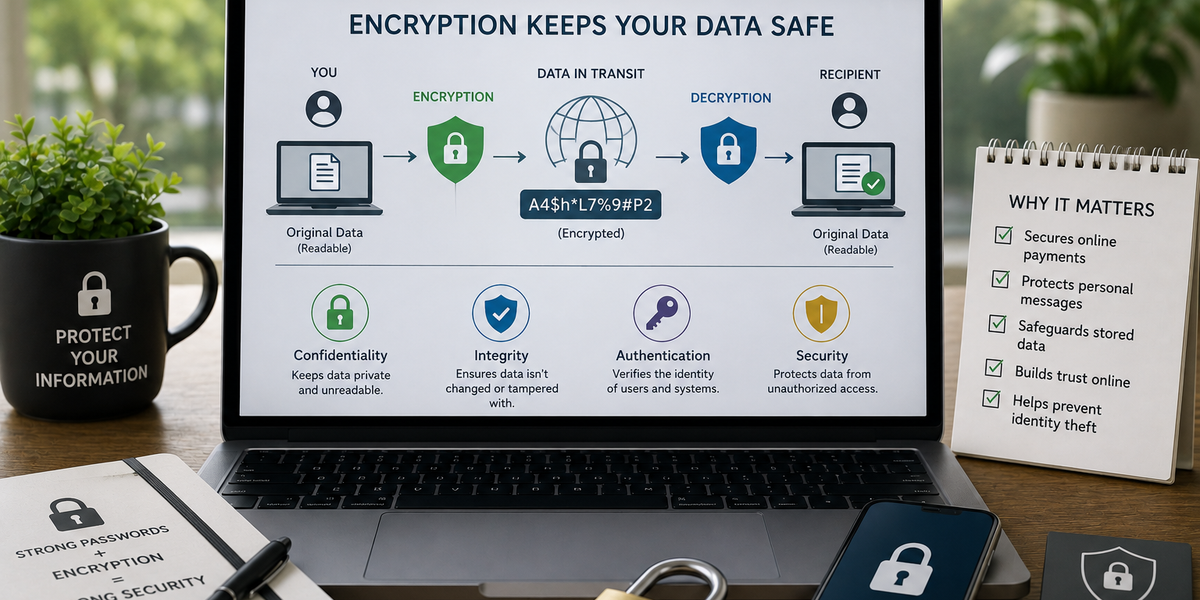
How Encryption Keeps Your Data Safe
Every day, people send messages, make online payments, store photos, log in to accounts, and share personal information over the internet. Much of that data travels through networks or is stored on devices and servers that could become targets for theft or unauthorized access.
Encryption helps protect that information by turning readable data into a scrambled form that cannot easily be understood without the correct key.
It is one of the main technologies behind online banking, secure websites, messaging apps, cloud storage, password protection, and digital payments.
Encryption does not make a system impossible to attack, but it makes sensitive information much more difficult to read if it is intercepted or stolen.
What Is Encryption?
Encryption is the process of converting readable information into coded data.
The original readable information is often called plaintext. After encryption, it becomes ciphertext.
For example, a message such as:
“Meet me at 10”
might be transformed into something that looks like:
“7Xq9!Lm2#P4”
The encrypted version is not meant to make sense to anyone who sees it.
To return the information to its readable form, the system uses a process called decryption. Decryption requires the correct cryptographic key.
A key is a digital value used by an encryption algorithm to lock or unlock information.
Without the correct key, encrypted data should be extremely difficult to interpret.
A Simple Way to Think About Encryption
Imagine placing a letter inside a locked box.
The letter is your original data. The locked box represents encryption. The key allows the intended person to open the box and read the message.
If someone steals the box during delivery, they may possess it but still be unable to read what is inside.
Digital encryption works differently and relies on mathematics rather than a physical lock. However, the basic purpose is similar: protecting information from people who are not authorized to access it.
Encryption in Transit
Encryption in transit protects information while it moves between devices or systems.
When you log in to a website, your username and password travel from your device to the website’s server. Without protection, someone monitoring the connection might attempt to intercept the information.
Secure websites use HTTPS to encrypt data while it travels.
The padlock symbol in a browser usually indicates that the connection between your browser and the website is encrypted.
This helps protect information such as:
- Passwords
- Payment details
- Personal messages
- Search activity
- Form submissions
- Account information
However, the padlock does not guarantee that the website itself is trustworthy. It means the connection is encrypted.
A fraudulent website can also use HTTPS, so it is still important to check the website address and avoid unfamiliar links.
Encryption at Rest
Encryption at rest protects information while it is stored.
Data may be stored on:
- Smartphones
- Laptops
- Hard drives
- Cloud servers
- Company databases
- Backup systems
If a laptop is lost or a storage system is stolen, encryption can make the stored information difficult to access without the correct password, key, or authentication method.
Many modern smartphones encrypt stored data automatically.
When you unlock your phone using a passcode, fingerprint, or facial recognition, the device may use that authentication to provide access to encrypted information.
A strong screen lock therefore protects more than the display. It may also help protect the encryption keys connected to your data.
Symmetric Encryption
Symmetric encryption uses the same key to encrypt and decrypt information.
You can think of it as a locked door where both people use copies of the same key.
This type of encryption is fast and efficient, making it useful for protecting large amounts of data.
The challenge is sharing the key securely. If an unauthorized person obtains it, they may be able to decrypt the information.
Symmetric encryption is commonly used for stored files, databases, and parts of secure internet communication.
Asymmetric Encryption
Asymmetric encryption uses two connected keys:
- A public key
- A private key
The public key can be shared openly. The private key is kept secret.
Information encrypted using the public key can be decrypted using the corresponding private key.
Imagine a mailbox that anyone can place a letter inside but only the owner can open. The public key allows people to send protected information, while the private key allows the recipient to access it.
Asymmetric encryption helps establish secure connections and supports technologies such as digital certificates and digital signatures.
It is often used together with symmetric encryption because symmetric encryption is generally faster for handling large amounts of data.
What Is End-to-End Encryption?
End-to-end encryption is designed so that only the sender and intended recipient can read the content.
The message is encrypted on the sender’s device and decrypted on the recipient’s device.
The company operating the messaging service may carry the encrypted information between users without having the key needed to read the message itself.
This can provide stronger privacy than systems where messages are decrypted on a company’s servers.
However, end-to-end encryption does not protect everything.
Someone who gains access to an unlocked phone may still read the messages. Screenshots can still be taken, and recipients can copy or share information.
Encryption protects the message during transmission and storage within the encrypted system. It cannot control what an authorized recipient does after opening it.
How Encryption Protects Online Payments
When you enter payment information on a secure website, encryption helps protect the data as it travels between your device, the business, and payment systems.
Banks and payment companies also use encryption to protect stored financial information and communication between systems.
Other security measures may work alongside encryption, including:
- Fraud monitoring
- Multi-factor authentication
- Payment tokens
- Access controls
- Transaction alerts
Encryption is important, but financial security depends on several layers of protection.
What Are Encryption Keys?
Encryption keys are essential because they control access to encrypted information.
Modern keys are usually long digital values designed to be extremely difficult to guess.
The strength of encryption depends partly on the algorithm, key length, implementation, and how securely the keys are stored.
If encryption is strong but the key is exposed, the information may no longer be protected.
Organizations often use specialized systems to generate, store, rotate, and control access to encryption keys.
For individuals, passwords, device passcodes, recovery keys, and account security can all affect access to encrypted information.
Can Encryption Be Broken?
Strong modern encryption is designed to make unauthorized decryption extremely difficult.
Rather than trying to break the encryption directly, attackers may look for easier weaknesses.
They may:
- Steal passwords
- Send phishing messages
- Install malicious software
- Exploit software vulnerabilities
- Access an unlocked device
- Trick someone into sharing information
This is why encryption should be combined with other security practices.
Strong passwords, software updates, multi-factor authentication, secure backups, and caution around suspicious links remain important.
Why Password Strength Still Matters
Encryption cannot fully protect an account if the password is easy to guess or has been stolen.
Use long, unique passwords for important accounts. Avoid reusing the same password across several services.
If one company experiences a data breach, reused passwords may allow attackers to access unrelated accounts.
A password manager can generate and store unique passwords, reducing the need to remember each one.
Multi-factor authentication adds another layer by requiring additional proof of identity, such as a temporary code or security key.
Encryption Is Part of Everyday Technology
You may use encryption many times each day without noticing it.
It can protect:
- Online banking
- Shopping transactions
- Messaging apps
- Video calls
- Cloud files
- Work systems
- Smartphone data
- Wi-Fi connections
Most encryption works quietly in the background. You do not need to understand the mathematics to benefit from it.
Encryption keeps data safer by changing readable information into a protected form that requires the correct key to unlock.
It helps prevent intercepted or stolen information from being immediately useful to unauthorized people. Combined with strong passwords, updated software, multi-factor authentication, and careful online behavior, it provides one of the most important layers of modern digital security.